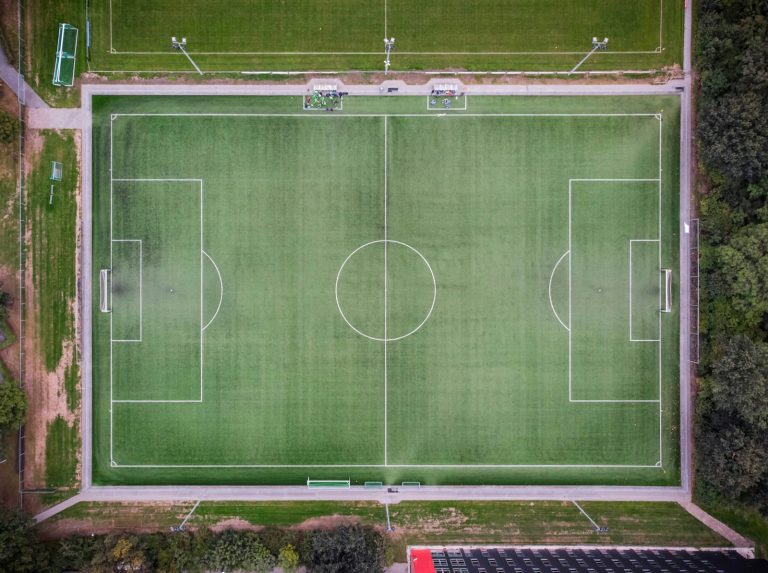
Not a night in front of the telly, and not a charity tournament: we’re talking about playing a football match with your mates, usually 5-a-side. The match lasts an hour. Organising it can take three evenings of messages. Here’s a 7-step method that works, whether you do everything by hand or use an app to organise your football matches.
The short version
- A fixed slot, a booked pitch, an exact number of places.
- A waitlist for dropouts, because there will be some.
- Teams sorted before you get to the pitch.
| Format | On the pitch | Players to invite | Usual length | Pitch (1h / 90 min) |
|---|---|---|---|---|
| 5-a-side | 10 | 10 to 12 | 1h or 90 min | about £35 to £70 / £52.50 to £105 |
| 7-a-side | 14 | 14 to 16 | 1h to 90 min | 3G pitch at a centre or from the council |
| 9v9 | 18 | 18 to 20 | 90 min | council pitch |
| 11-a-side | 22 | 24 to 26 | 90 min to 2h | council grass pitch |
At every step, you’ll find the do-it-yourself version and the version with Footinho, a free, ad-free app for organising football matches with friends, on iPhone, Android or in a browser, run by a non-profit association. You don’t need the app to follow this guide.
1. Choose the format and set the number of places
With mates, colleagues or for your Tuesday night game, the most common format is 5-a-side: 10 players, or 12 with one sub per team. Then comes 7-a-side and, for bigger groups, 9v9 or 11-a-side.
Set an exact number of places, not “about 12”. And be realistic: the bigger you go, the harder it is to fill. If you’re just starting, go for 5-a-side, indoors or on a 3G pitch.
➜ Format by format: How Many Players in a Football Team? 5-a-Side to 11-a-Side
2. Choose a slot and keep it
Weekday evenings around 7 or 8pm is the slot everyone wants: handy for players, but also the most expensive and the first to go. As for length, an hour is plenty for 5-a-side with ten players; lots of groups book 90 minutes to get their breath back and rotate the subs.
Most importantly, keep the same slot every week. “Tuesday 8pm” becomes a habit, and people keep the evening free without you having to ask again.
With Footinho: when you create the next match, it’s pre-filled with the same day and time. You just confirm.
3. Book the pitch before you open sign-ups
Book the pitch first, invite second. The other way round, you end up with 10 players for a slot that no longer exists.
Choose a pitch that’s close for most of the group, with parking or good transport links: a pitch 40 minutes away means guaranteed dropouts. Going by the price lists venues publish, expect about £35 to £70 for an hour of 5-a-side depending on the city and the time, and £52.50 to £105 for 90 minutes. Council pitches and courts can be cheaper and are booked through the council or its leisure trust, but clubs often get the season lets first. Open-access park pitches and MUGAs are free, but you can’t book them.
With Footinho: the app doesn’t book pitches; you do that with the centre or the council. Then you add the pitch to the match page, so everyone knows where to go.
➜ Prices by city, off-peak times and deals: Football Pitch Hire: Prices for 1 Hour and 90 Minutes
4. Invite 3 to 7 days ahead and get everyone to confirm
Any earlier, people don’t know what they’re doing yet. Any later, they’ve already made other plans.
For 10 places, you need a group of 12 to 14 players: some regulars and a few occasional ones. Ask everyone to confirm clearly: in / out / maybe. Count a “maybe” as a no until it becomes a yes. And set a deadline.
An invite you can copy:
⚽ 5-a-side Tuesday 8-9.30pm at the leisure centre. 10 places, £6 each. Reply by Thursday lunchtime: in / out. After 10, you go on the waitlist.
Without an app: a poll or an event in your WhatsApp group, with the answers and the deadline written in the message.
With Footinho: you share the invite to your WhatsApp group in two taps (or by text, email…). Everyone taps the link and answers in one tap, and the “8/10” counter is visible to all. Players you invite in the app get the invite by email and notification, then one automatic reminder if they haven’t replied: two nudges, without you writing a single message.
➜ The full method: 5-a-Side Availability: 5 Rules to Know Who’s Playing
5. Be ready for dropouts and missing players
They will happen, often the day before or on the day. Three ways to cope:
- A waitlist. Once the match is full, the next people wait. If someone drops out, the first person on the list takes their place.
- A simple rule, announced from the start. For example: “drop out the day before and you pay your share or find a replacement.”
- A plan B if you’re short. Ask confirmed players to bring a mate, open the match to other local players, or go smaller (from 7-a-side to 5-a-side).
Without an app: write the waitlist under the list of players, in the order people replied. When someone drops out, message the first person on the list yourself.
With Footinho: turn on the waitlist for the match. When a place frees up, the first person on the list moves into the match and gets notified. If the match isn’t full the day before, you’re the one who gets an alert, and you can make it a public match so local players can join. Each player’s profile also shows their reliability: their response rate, and how many times they’ve been reported as a no-show, leaving at the last minute or turning up late.
6. Sort the teams before you arrive
Ten minutes of “no way, your team’s stacked” by the side of the pitch is ten minutes less football. Make balanced teams the day before:
- Put the players into three ability groups (strong, average, beginners).
- Share out each group in turn: one for A, one for B.
- Split up the inseparable pairs, especially if they play well together.
- Put a goalkeeper, or at least someone happy to start in goal, in each team.
No time? Pick two captains who choose in turn, or draw names by ability group. If one team is 5-0 up after ten minutes, swap two players.
A few house rules to agree before kick-off: rotating keeper (change after every goal conceded, or every 10 minutes), subs coming on every 7 to 10 minutes, no slide tackles, and fair play. With 11 or 13 players, play “next goal wins”: the team that concedes goes off and the subs come on.
Without an app: put the teams in the day-before recap (step 7).
With Footinho: you set the lineups in the match tab, and every player sees them before leaving home.
7. Send the recap the day before
One message, the day before: where, what time, the teams, who’s bringing what, how much everyone owes. For the money, get people to pay before the match by bank transfer, a Monzo payment link or PayPal: far easier than chasing people outside the changing rooms.
Kit not to forget:
- a ball (often provided at 5-a-side centres, check) and a pump;
- two sets of bibs in different colours;
- the right footwear for the surface (3G or indoor) and shin pads;
- gloves for the keeper, and water.
A recap you can copy:
Tomorrow 8pm at the leisure centre, pitch 3. Team A: Jamie, Leo, Sam, Callum, Max. Team B: Ollie, Tom, Ravi, Dan, Alex. Leo’s bringing the ball, Tom the bibs. £6 each, payment link below.
With Footinho: confirmed players get a reminder 4 hours before the match. The recap is still useful for kit and money: the app doesn’t handle payments.
And after the match?
This is where a group holds together or falls apart. A pint after the match (the losers get the round in, it’s a classic), a message the next day with the score and the best moments, and above all: announce the next slot straight away, while everyone’s still up for it.
With Footinho: players vote for the Man of the match, and next week’s match takes seconds to create, pre-filled with the same day and time.
Try Footinho for your next match
Footinho is free, ad-free and run by a non-profit association. It doesn’t book the pitch or handle money, but it takes care of replies, reminders, the waitlist, lineups and the Man of the match vote. Create your match →