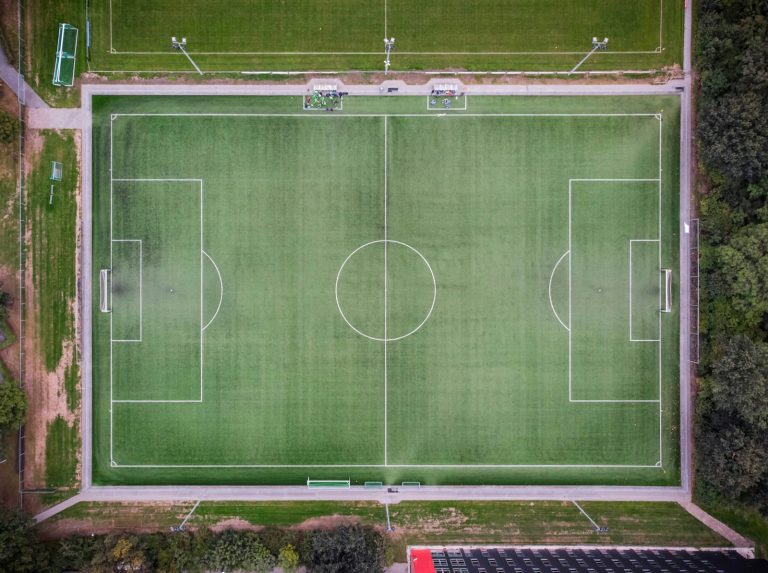
It’s in the name: 5, 7, 9 or 11 players per team on the pitch, goalkeeper included. So an 11-a-side team is 1 goalkeeper and 10 outfield players. When you’re playing with mates, the real question is how many to invite so the match actually happens.
How many players in a football team, by format
| Format | Per team | On the pitch | Minimum to play (rules) | Invite for a match with friends |
|---|---|---|---|---|
| Futsal | 5 (4 + goalkeeper) | 10 | 3 per team | 10 to 12 |
| 5-a-side | 5 | 10 | no official rule | 10 to 12 |
| 7-a-side | 7 | 14 | set by your league or centre | 14 to 16 |
| 9v9 | 9 | 18 | set by your league; youth format for U12s-U13s in England | 18 to 20 |
| 11-a-side | 11 | 22 | 7 per team (Laws of the Game) | 24 to 26 |
Sources: IFAB, Law 3 of the Laws of the Game, Futsal Laws of the Game, England Football, game formats by age group.
How long is a football match, and how big is the pitch?
| Format | Match length | Pitch size |
|---|---|---|
| Futsal | 2 × 20 min of actual playing time | 25 to 42 m × 16 to 25 m |
| 5-a-side | 1-hour or 90-minute booking, no set halves | varies by centre |
| 7-a-side | set by your league or centre | varies by venue |
| 9v9 | set by your league | varies by venue |
| 11-a-side | 2 × 45 min | 90 to 120 m × 45 to 90 m (100 to 130 yd × 50 to 100 yd) |
5-a-side vs futsal: not the same thing
People often mix them up, but the rules are different.
- Futsal is an official sport with its own Laws of the Game: 4 outfield players and 1 goalkeeper, up to 9 subs in official competitions, and unlimited substitutions at any time, rolling subs like in basketball.
- 5-a-side is the game you play at a 5-a-side centre: a 3G pitch, often enclosed by boards or netting, one-hour slots. Each centre sets its own rules, but you’ll often find: no offside, no slide tackles, the ball stays in play off the boards, a keeper’s area outfield players can’t enter, and at many centres a head-height rule.
How many to invite? 10 if you want to play without breaks, 12 if you want a breather. An hour of 5-a-side flat out is intense: two rotating subs help a lot, and the pitch hire gets split between 12 instead of 10.
7-a-side: the sweet spot
7 players per team, goalkeeper included, usually on a smaller pitch or part of a full-size 3G. In England, from the 2026-27 season, 7v7 is the format for U10s and U11s. For adults, there’s no single national rule: your league or centre sets the details.
How many to invite? 14 at least, 16 to have one sub per team. It’s more physical than 5-a-side, and running for 50 minutes without a break hurts.
9v9: the youth format
A 9v9 team is 8 outfield players and a goalkeeper. In England, from the 2026-27 season, it’s the format for U12s and U13s. Among adults, it’s mostly a fallback: you wanted 11-a-side and only 18 turned up? Play 9v9 on a smaller pitch.
11-a-side: the real challenge
11 per team, 22 on the pitch. The Laws of the Game don’t allow a match to start or continue if either team has fewer than 7 players. In England, from the 2026-27 season, youth teams move up to 11v11 at U14s. In a competition, a team without enough players usually has to forfeit the match: check your league’s rules.
How many to invite? At least 24, ideally 26: 2 to 4 subs for the whole group. And be realistic: with friends, it’s by far the hardest format to fill. If you’ve only got 18 signed up the day before, switch to 9v9 rather than calling it off.
How many subs in football?
In official competitions, the competition rules set the number of substitutes and whether a player who comes off can go back on. The Laws of the Game allow more substitutes in other matches if both teams agree and the referee is told beforehand, and “return substitutions” are allowed in youth, veterans, disability and grassroots football if the national association agrees. In a kickabout with friends, there are no limits: rotate freely, and anyone who comes off can go back on.
Should you invite more people than places?
Not necessarily. Inviting loads of people “just in case” means you might end up with 14 for 10 places, and have to tell four mates they came for nothing.
The method that works best: set the exact number of places and open a waitlist. The first to reply play, the next ones wait. If someone drops out, the first person on the list takes their place. Nobody turns up for nothing, and the match stays full.
Without an app: write the waitlist under the list of players, in the order people replied, and message the first person yourself when a place frees up.
With Footinho (a free, ad-free app for organising football matches with friends, on iPhone, Android or in a browser, run by a non-profit association): you set the number of places and turn on the waitlist. The counter (“9/10”) is visible to everyone, and as soon as a place frees up, the first person on the list moves into the match and gets notified.
Short of players the day before?
In this order:
- Chase the people who said “maybe”: they’re your quickest option.
- Ask each confirmed player to bring a mate.
- Open the match to other local players.
- Go smaller: from 7-a-side to 5-a-side, from 11-a-side to 9v9.
With Footinho: you get an alert the day before if the match isn’t full, which gives you time to do all of that. And you can make your match a public match so local players can join.
Try Footinho for your next match
Number of places, waitlist, an alert the day before if you’re short: Footinho takes care of it, free and without ads. Create your match →
➜ Read next: How to Organise a 5-a-Side Match with Friends: 7 Steps